“Data Transfer” or the Risk of Digital Exile
In a world where data has become the central strategic asset for societal prosperity and economic competitiveness, a fundamental question arises: who truly holds the keys to our digital future?
For a long time, data utility was prioritised at the cost of data control. Today, hosting sensitive data—whether healthcare, industrial, or sovereign—on foreign infrastructures exposes organisations to a genuine “digital exile.” This risk is no longer merely theoretical: the application of extraterritorial legislation (such as the U.S. CLOUD Act) allows third-party authorities to access strategic digital assets. This situation creates a power asymmetry where stakeholders fear a loss of control and a major competitive disadvantage.
Confronted with these threats, the concept of data sovereignty emerges not as a protectionist stance, but as an instrument of freedom. It is defined as the self-determination of individuals and organisations regarding the use of their own data.
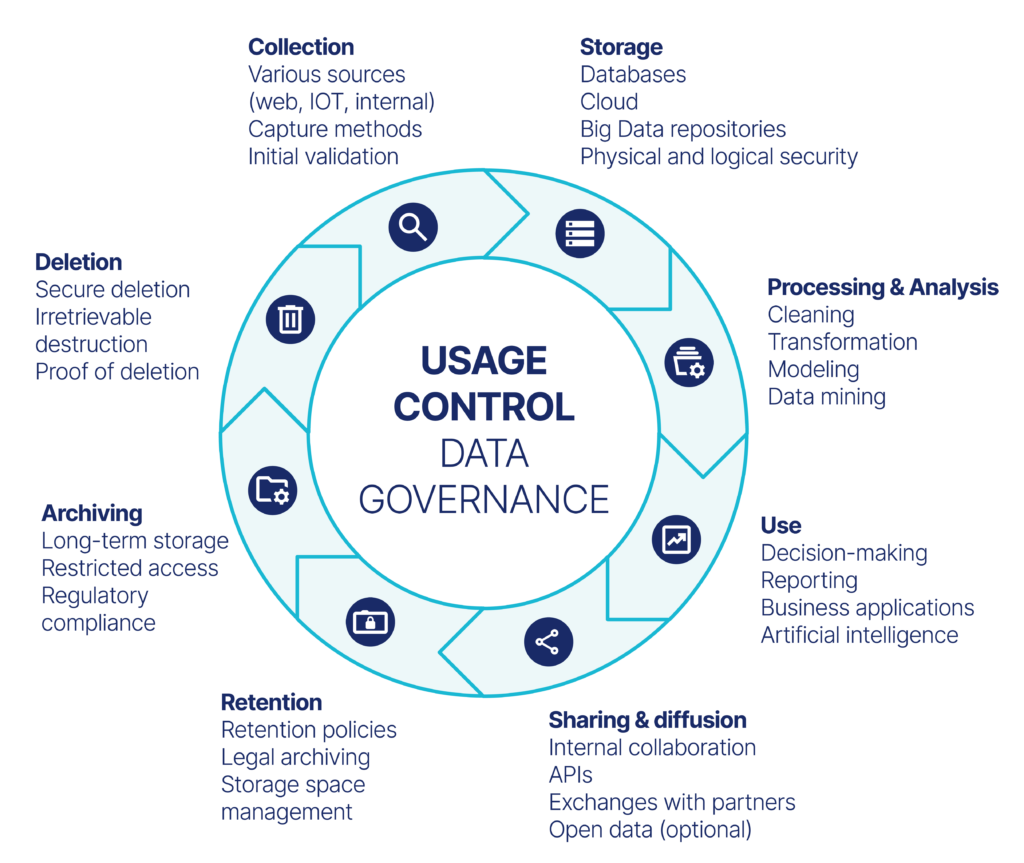
For the cybersecurity architect, sovereignty goes beyond simple legal compliance; it becomes a technical design challenge (Sovereign by Design). It involves building trusted environments where both the provider and the consumer can monitor and control every action performed on their assets. The challenge is to shift from a state of forced dependency to genuine autonomy, where data remains under the exclusive control of its creator, from its creation to its destruction.
Data Residency vs Data Sovereignty
For the general public, the notions of residency and digital sovereignty often seem interchangeable. However, in information systems architecture, they describe radically different strategic realities that every expert must distinguish to ensure the true protection of digital assets.
Data Residency
Data residency is defined primarily as a geographic and legal constraint. It mandates that data, once converted into digital form, must be physically stored and processed within the borders of a specific country. The core objective of this approach is to ensure that data is subject exclusively to the laws and regulations of that particular nation. However, for the architect, residency is a necessary but often insufficient condition. The limitation of this model lies in its inability to protect data against extraterritorial jurisdictions: storing data on a local server is futile if the infrastructure is operated by an entity subject to foreign laws, such as the U.S. CLOUD Act, which allows data access by a third party without the owner’s consent.
Data Sovereignty
Data sovereignty, conversely, is a capacity for self-determination that goes beyond the simple question of physical location. It concerns the exclusive and autonomous control exercised by an individual or an organisation over the use of their digital asset. Where residency is similar to a matter of “land registry” or soil, sovereignty is a matter of the “lock” and global governance. It relies on the implementation of Usage Control, which differs from traditional access control. While access control merely verifies entry into the system, sovereignty requires the ability to specify and enforce strict usage conditions even after access has been granted. In this vision, the architect enables the owner to define precise rules, such as prohibiting file copying or limiting its retention period to 24 hours, thereby guaranteeing total mastery across the entire value chain.